Showing posts with label parking lot. Show all posts

Thursday, May 2, 2013

Chevelle SS


Wednesday, April 24, 2013

Another member of the flock

Another Lotus has come home for the summer from wherever it migrated over the cold seasons (probably a nice heated garage), it promptly went shopping Uptown.


Thursday, April 18, 2013

Chevy Malibu

This sweet Chevrolet Malibu was parked near the VA hospital. It has most likely been restored recently, as evidenced by the shiny paint (in hot-rod red with stripes) and clean chrome.


Tuesday, April 9, 2013

From the Archive: Model T hot rod

This is a Model T I saw in front of a radiator shop about six years ago.


It had a piece of steel welded in for a roof, a small block Chevy motor with an automatic transmission, the interior consisted of the steering wheel, some house carpet, and a bench seat from a small pickup truck, the seam from the (approximately) 4-inch chop is clearly visible. This hot rod was for sale, after seeing it sit for several months I contacted the owner and learned that he was asking ONLY $13,000. Somebody eventually did buy this Rustoleum-covered deathtrap, and the dope chopped Model A two-door sedan in the background. I hope they had some money left for seat belts.


Sunday, April 7, 2013

The Toyota Corolla of Classic Cars

When someone says "classic car" the first things that always come to mind are two-tone paint jobs, excessive chrome accents, sweeping compound curves, and enormous tail-fins. While there have been many cars that fit this description, there is no more common an example of it than the Chevy Bel-Air.


 While the Bel-Air remains a beautiful example of the artistry of fifties car-design, the question that has to be asked is: What is the purpose of owning a classic if everyone else on the road has one just like it? Every person who has some money and decides to spend it on vintage cars, appears to begin their collection with a fifties-era Chevy. 


Part of the reason for this is that the car was exceptionally popular when it was new. From 1954-1957, more than 2,630,000 cars bearing the "Bel-Air" monicker were produced, according to chevy.oldcarmanualproject.com. This makes parts comparatively easy to find, and therefore makes the cars easy to restore. However, there are problems that arise as a result of this. Part of where antique cars get their value is from something called the economy of rarity, wherein the fewer of something there is, the more that thing is worth. 


This concept applies to intrigue as well. The more of a certain type of a thing there is floating around the more likely people are to think, "oh another such-and-such" and thus diminish the curiosity value of that thing. The Bel-Air appears to be in severe danger of falling into this category. This doesn't have to be the case however. There are plenty of other cars from around the same era that are possessed of just as much integrity and virtuosity of styling as the Bel-Air, and which should be able to curb our obsession with it.

The stately Chrysler, for example,

monstrously befinned Plymouth,


regal Buick,

or imposing Mercury.

This is a call to action for classic car owners and lovers, shift your focus away from the Chevy Bel-Air and instead spend all the time and energy that goes into restoration on some of these more unique and unusual, but no less beautiful and quintessential classics. In so doing you will rescue the Chevrolet Bel-Air from being relegated to the "meh" column of history, as well as foster some appreciation for other hallmarks of automotive design.


Saturday, April 6, 2013

Midget, Or 'Little Car'

This cute MG Midget was in a parking garage downtown, the person who owns it must live in the apartments above based on the presence of an oil pan to catch this leaky buzzard's leavings. The leather tonneau cover for the cockpit really caught my eye.


This is a late 70s model add indicated by the grotesque plastic bumpers. Despite the bumpers I think these little British cars are just the bees knees.


Thursday, April 4, 2013

Kawasaki Bobber

When leaving the local pub last weekend I happened upon this Kawasaki bobber. It was  very dark so my phone's flash had to work overtime on these photos. Nevermind the dorky scooter in the background.

Red spokes, always a hit with the hot rod crowd.
Solo seat.

The best part was the lace paint job on the tank, despite this photo the paint was more of a root beer color than red or pink.


Sunday, March 31, 2013

Two-Toned Class

This restomod was leaving the local auto parts store while I was headed home from the surplus store. The paint was very shiny with cool scallops, a badge on the side claimed to herald a V8, and the vanity plate says 'sparki.'


I'm not super familiar these cars, it's probably late thirties era Ford or Chevy .

Thursday, March 28, 2013

Off-Roadie

I recently took a trip to my favorite surplus store, and upon leaving found this beast of a sand-rail/dune buggy parked out front. This is clearly a fairly high-dollar off-roader, all the paint and chrome, the high build quality, and the registration (not simple to get for these vehicles) point to a deep wallet or an un-cluttered schedule.

Plug plug plug.


Major suspension at work.

It's only two wheel drive.

All-business two-seater cockpit.


Plenty of lighting.

Fuel cell and cargo area behind the seats.

Exposed controls ahead of the cockpit.


Sunday, March 24, 2013

Going Postal!

Saw this trio of postal jeeps parked behind a post office in Corrales. While they weren't dripping with custom panache they're good examples of the iconic American off-roader.


The Jeep was originally developed by the Bantam car company in response to a call from the government for a lightweight scout vehicle. Bantam developed the original prototype but the government licensed the design to Willys and Ford to actually produce (thinking that Bantam was not large enough to build them in the quantities needed). The distinctive stamped grill was actually added by Ford, and kept by the Army for the production vehicles. 


Willys was the only manufacturer to continue building the jeep after the war, and were given the trademark for the name because of that. The brand went through many owners before ending up with Chrysler.


It is commonly believed that the name comes from the Army's original designation of General Purpose or GP vehicle. The original Bantam prototype was called the Bantam Reconnaissance Car or BRC; imagine if the iconic American 4x4 had been called the Brick!


Sunday, March 10, 2013

From the Archive: Gran Torino

Cool Ford Gran Torino, this lived near the Dodge Polara and I saw them around the same time period. It needs a little love, but still has 'muscle' written all over it.


Saturday, March 9, 2013

From the Archive: Dodge Polara

This is a Dodge Polara coupe I saw in early 2008. I was instantly attracted to this car with its green paint, dark tinted windows, wedge-shaped taillights, and aggressive nose-down stance. The body style indicates that this car was made between 1970 and 1973, but the grill isn't like any I've been able to find.  This style was made for a relatively short period of time, making them mildly uncommon now. I think this is one those overlooked, almost classic vehicles that everybody would want if they knew it existed. I know I want one.


Tuesday, March 5, 2013

From the Archive: Mystery Car (Mystery Solved!)

This is from late 2007, I saw this car in a fenced business yard near my storage unit. It's clearly a 1940's design, with bold and beautiful curves all around, great bullet bumper features, and wrap-around windshields. It's also a custom (I believe) with a truck bed on the back. This could have been inspired by the car/truck hybrids of later years, or could be a VERY early factory version of the El Camino (production began in '59) or Ranchero (in '57) but I've never seen anything like it, before or since. I would speculate that the rear windshield is the stock one, with the entire window frame moved forward and welded to the B pillar. As I said, this was in 2007, the car has long since disappeared and I've always been too shy to ask about it.
Does anyone else have any clues or insights on this mystery machine?


Post Script: This is the first of what I'm going to call an 'Archive Series.' Until now all the cars featured on the blog have been spotted recently, within six weeks of posting, but I'm sitting on a huge cache from the last seven years or so, which will be making their way up. Many of these will be poor photos, and some I won't remember any details about, but hopefully some of our helpful readers can add their own history or opinions to augment my own. You can all look forward to even more cool stuff in the near future!

UPDATE!
Thanks to a helpful Pinterest follower this mystery car has been identified! A 1954 Cadillac-Superior Flower Car. A quick Google search turned up this image:

Soure
It's definitely the right car. It is not a custom after all, but nor is it a production Cadillac. Superior is a coach-building company, they began as a professional car building company, making school buses, ambulances and hearses. Superior would buy Cadillac's and turn them into whatever vehicle was on order,building the body n trim to suit. Apparently, in the early and middle half of the 20th century, on the East Coast it was popular and traditional to have a 'flower car' carrying all the flower arrangements for a funeral to be part of the funeral procession. These flower cars would have to have been as classy and dignified as the hearse they were following. So, its not quite a production or custom vehicle, it's in the same category as ambulances and hearses, but clearly with a style all its own.
Thanks to Andre Simpson for the tip!


Wednesday, February 20, 2013

Friday, February 15, 2013

The Supernationals: the Hot Rods

Always one of my favorite and most under-represented kind of car is the hot rod. These pre-1940 cars were lightweight and cheap after the war, and in the late forties and fifties many returning soldiers looking for excitement got themselves an old Ford, Chevy, Dodge (or Other) coupe, took out all the unnecessary junk, tuned the engine for performance and went racing. Early hot rodders were considered a menace (the term 'hot rod' was a pejorative originally, referring to the high performance crankshafts being installed), due to their dangerous street racing, eventually many of them were forced to start early dragstrips and retreat to the salt flats to meet their racing needs. In the 1960s, following the rise of high chrome and fancy paint schemes from the factories, hot rodding moved towards the 'show car' mentality, hot rods were painted wild colors, given gobs of chrome (chroming the frame of the car even became standard eventually) and some were built with themes, Ed 'Big Daddy' Roth was one of the most influential and prevalent members of this time period. The hot rod culture has swung back and forth ever since, frequently depending on the economy to dictate which style is in fashion.

The 1932 Ford roadster is considered by many to be the epitome of hot rods, it was the first factory V8 available and sold in such great numbers that they were affordable all the way into the 60s. They are such an icon of motoring that numerous songs have been written about this one car, and they are still being produced as fiberglass replicas.


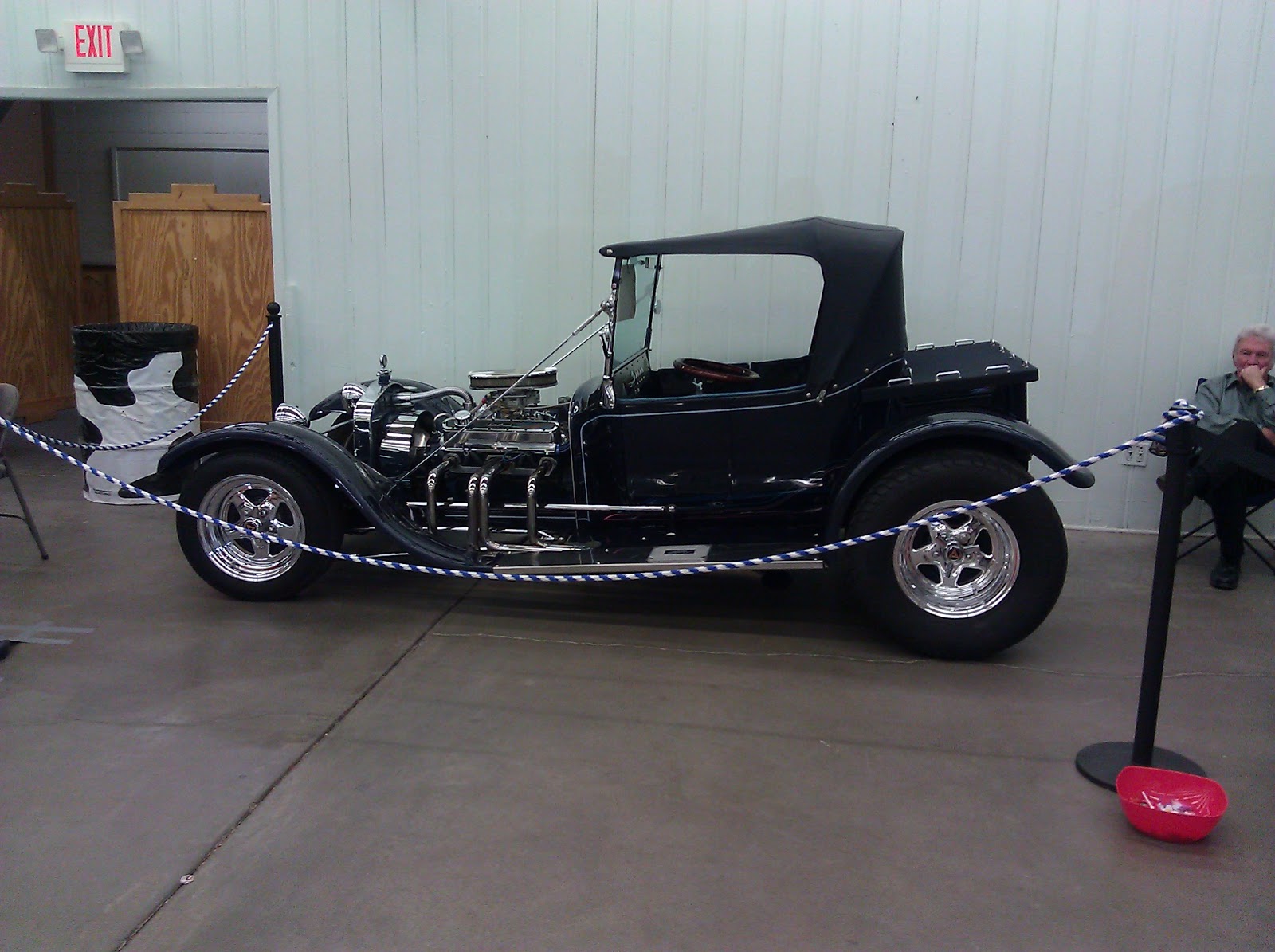
Commonly called 't- buckets' these cars were built with the body of a Ford Model T, which was essentially a steel tub with seats in it. These are good examples of the stripped down but still high dollar show cars that became popular in the sixties.


Here is an example of an excellent Ford Model A coupe, with a modern Chevrolet V8 powerplant in front.


Classic post-war influence.
A newer trend in hot rodding is the so-called 'volksrod.' As with the early trend setters, Volkswagens are affordable and easy to work on. This one has a chopped roof, suicide doors and the fenders have been removed. The moon covers on the wheels are a classic salt flat racing accessory.

Dig the upholstery.

This wild car is a perfect example of the excesses that come with purpose-built show cars. Every surface is either chrome or deep black. The 'body,' which resembles a t-bucket, is actually steel bars forming a cage, which is also fully chromed, a theme that carries over to the grill. The engine is another modern Chevy small-block, with a huge chrome supercharger and twin chrome carburetors.


Notice the mirror under the car, so you can see the various chromed and painted under-surfaces.
Outside the show we saw this cool themed hot rod, inspired by a hearse. The body is most likely fiberglass, the suspension is all chrome, the interior has a pleasant style to it, and there are many fun details such as the taillights to discover on your own. It's also for sale!